
This is the latest post in our series on Zohran and the Knicks. Read previous installments here.
Who are the Knicks’ biggest rivals?
It’s not an obvious question to answer. Thanks to the way the NBA structures its divisions and its schedule, its rivalries tend to come from repeated playoff matchups, instead of the regular season or geography. And since the Knicks only recently broke an extended playoff drought, they haven’t had a lot to pick from: Most of their rivals still date from the 1990s.
You could make a strong argument that New York’s biggest rivals are the Miami Heat. The teams have history, iconic moments, and bad blood: In 1995, Pat Riley resigned from the Knicks (via fax) so he could take a job as team president of the Heat, a job he has held ever since, winning Executive of the Year and multiple championships. Two years later, the teams met in the playoffs for the first time; the Heat won a seven game series best remembered for the infamous PJ Brown brawl.
The Knicks would beat Miami in the playoffs in each of the next three seasons, but the Heat beat New York again in both 2012 and 2023. Miami has a reputation for relentless competence and stability: They’ve had the same coach and front office for decades now, and they’ve only missed the playoffs four times since 2003. Meanwhile, the Knicks have been known for volatility, extended mediocrity, and unmet expectations. So there’s both a legitimate contrast and actual animosity between the franchises.
But no, I think the actual answer most Knicks fans would give would have to be the Indiana Pacers. The 1990s series between New York and Indiana were even more cinematic than the ones with Miami — literally: One of the first great 30 for 30 films was about this rivalry. And, of course, Reggie Miller was a better antagonist than anyone on the Heat.
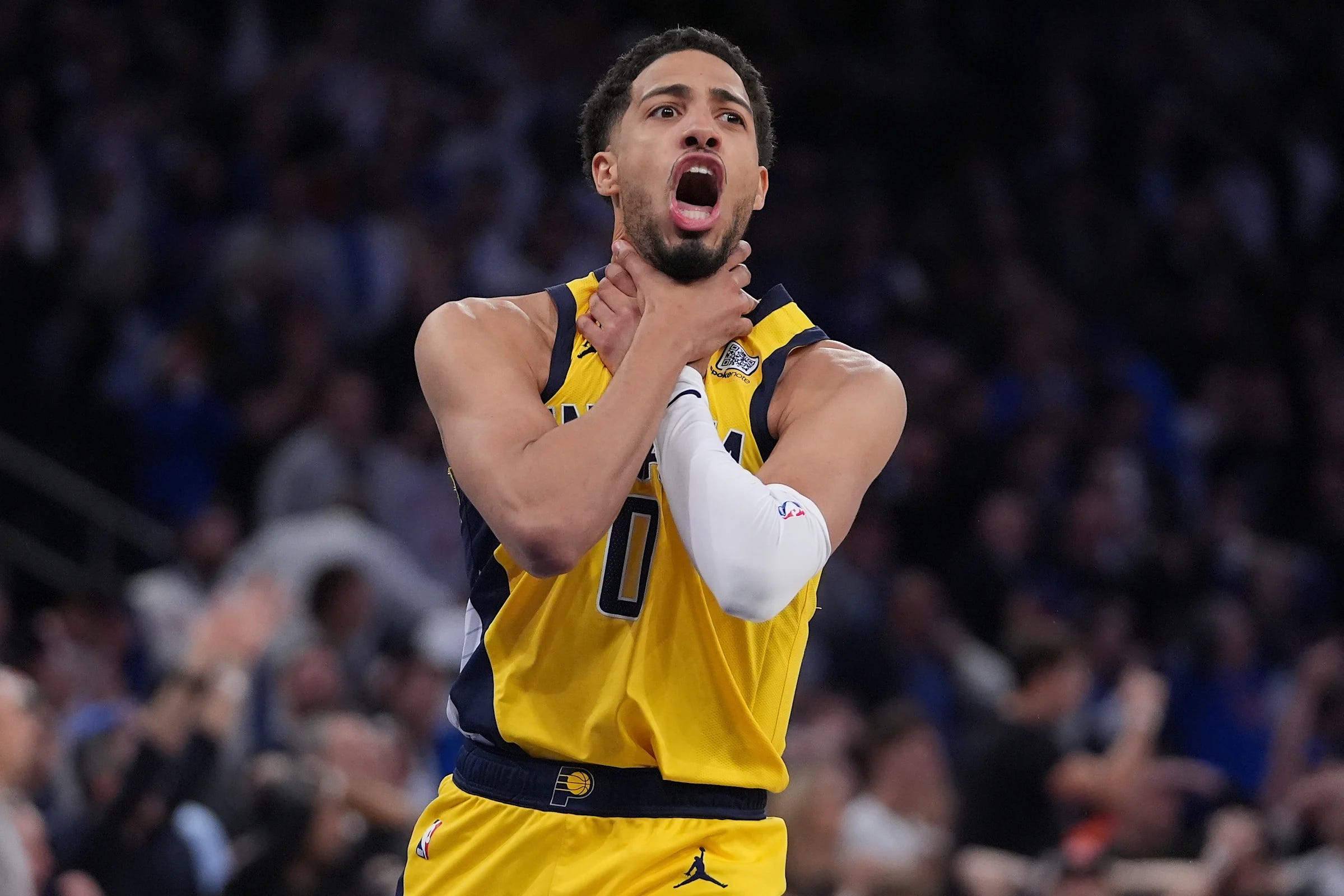
And it just so happened that the Pacers knocked the Knicks out of the playoffs in each of the last two seasons. When Tyrese Haliburton did the Reggie Miller choke gesture to cap off a jarring comeback in Game 1 of last year’s Eastern Conference Finals, it reopened wounds for Knicks fans that, it turns out, were still pretty raw.
When Haliburton then tore his Achilles in the NBA Finals, it was bittersweet. For one, it meant an anticlimactic end to the season, but it also meant the Pacers would be a non factor in the East, leaving the Knicks without an obvious antagonist for the 2025-26 season. Had Haliburton stayed healthy, then it would have been obvious what the Knicks would need to do for 2025-26 to be a “successful” season: beat the Pacers. If they could finally get past the team that knocked them out two years in a row, then Knicks fans could feel like progress was being made. If not, then you start to wonder if the window on this team is closed.
But with the Pacers mired in last place in the East, it’s been harder to pinpoint exactly what success means. Winning the Eastern Conference would feel like progress, but would it even feel worthwhile if you don’t go through Indiana? How good would it feel to beat the Pistons — a team that hasn’t won a playoff series since 2008 and doesn’t have a history of animosity with the Knicks?
Then last week, Jayson Tatum came back and I had a scary thought: Oh no, what if we just get swept by the Celtics? Tatum also tore his Achilles in the playoffs last year, and was not expected to contribute this year. But Boston has played much better than anyone thought in his absence — they have a better record than the Knicks — and now Tatum is back and he looks pretty good for someone coming off an Achilles injury.
Losing to the Celtics would hurt even more, oddly, because they’re NOT really a rival of the Knicks. That’s unusual for Boston and New York, who are natural rivals in most sports, but in the NBA they haven’t actually had much beef for as long as I’ve been alive. The Celtics have deeper, more historic rivalries with the Lakers and the Pistons and even the Heat. The Knicks are barely on their radar.
So watching the Celtics emerge, yet again, as the favorites in the Eastern Conference, is like watching the Knicks miss their moment. This was supposed to be a wide open year in the East, a year for the Knicks to finally return to the NBA Finals, and yet it’s starting to look like the window might already be closed. And the annoying piece of it is that, even if the Knicks do knock out Boston, it won’t feel like progress: After all, New York beat them last year,1 and this was supposed to be a down season for the Celtics. This is why rivals are important: We are whatever we are fighting against.
I fear we have lost track, a little bit, of the central figure in the political side of this story, Zohran Mamdani. Our timeline so far has mostly focused on 2020, when he was running a little-noticed campaign for State Assembly in Queens. But it’s worth spending a little time on his opponent in that race, Aravella Simotas, because of what an ill-suited foil she really was.
Last year, when Mamdani defeated Andrew Cuomo (twice), it became conventional wisdom in many circles to attribute his success to the weakness of his opponent. For many pundits, this was a way of pooh-poohing Mamandi’s success, and dismissing the appeal of socialism in general. And it obviously fails to provide a complete explanation for Mamdani’s victory; there were a dozen other, non-socialist candidates who ran against Cuomo and got virtually no traction.
But it’s also true that Andrew Cuomo WAS a perfect foil for a grassroots socialist campaign. Cuomo was a bully who had run the state for years, who was a longtime antagonist of both progressives and New York City politicians. Plus, he had two major scandals in his recent past: multiple verified instances of sexual harassment, plus his dishonest and incompetent handling of the Covid-19 nursing home deaths. There were a lot of voters who, when confronted with the idea of Cuomo’s return to power, would understandably flee in the other direction, regardless of any ideological preferences.
And Zohran was a perfect stylistic contrast. Cuomo was old; Zohran was young. Cuomo was a nasty bully; Zohran was always friendly and smiling. Cuomo seemed to hate New York City; Zohran obviously loved it. These differences only amplified their differences on policy and ideology, and made people who might normally be skeptical of socialism more amenable to what they saw as simply a rejection of Cuomo-ism.

This was an extreme example, but it was a pattern that the left was used to exploiting in New York City. There was the IDC, Joe Crowley, Melinda Katz, Martin Dilan, even Anthony Weiner — establishment figures viewed as corrupt or immoral or incompetent have been useful foils for progressives catapulting themselves into positions of power and prominence. Heck, this is even how Bernie’s initial campaign against Hillary went so well in 2016 — it’s not exactly a groundbreaking strategy.
But Aravella Simotas, the Assembly Member from Astoria that Mamdani challenged back in 2020, did not really fit this pattern at all. Simotas was young, only 42 at the time of the election. She was well-liked by her peers, and she faced no scandals. Nor was she an odd demographic fit for the district, as Joe Crowley had been; Simotas was an immigrant and her parents were part of the Greek diaspora,2 which has a strong presence in northern Queens. And she had deep ties to the City, going to public school and then Fordham for college and law school.
Nor was Simotas was a particularly easy foil on policy issues either. She had been endorsed by the Working Families Party. She supported progressive legislative priorities like GENDA and Raise the Age. (She even introduced legislation to close loopholes in the latter law.) One of her colleagues in the Assembly said, “I’ve worked with Aravella, and I’m not quite sure how you could be more left-leaning than she is.”
In other words, Simotas was not a natural villain for a socialist campaign. At several points during the primary, Simotas said that she agreed with every issue Mamdani had highlighted on his website. Even Zohran sometimes struggled to find points of contrast, bringing up years-old bills that had never even come to a vote.
In reality, there was nothing really wrong with Simotas on paper. She was a pretty standard, Obama-era progressive. The real reason that Simotas was targeted was quite simple: NYC-DSA was running a slate of candidates in 2020, and her district was densely populated with DSA members. This made it an enticing opportunity to grow the ranks of socialist legislators in Albany — which, prior to 2020, stood at exactly one.
Zohran Mamdani was a promising candidate and a committed socialist. He had held prominent roles in prior NYC-DSA campaigns, most notably Khader El-Yateem’s 2017 City Council campaign in Bay Ridge and Tiffany Caban’s 2019 run for Queens District Attorney. And it just so happened that he lived in Simotas’ district.
At the time, plenty of people picked up on what was going on, but Mamdani’s campaign couldn’t exactly come out and say that they were only going after Simotas because she wasn’t a socialist (hence all the harping on obscure bills). Political races in the US are supposed to be about the specifics of the candidates. During the campaign, Simotas emphasized that she had deeper ties to the district and that she WASN’T part of any broader movement: “I did not get into this business because you know, a club, a politician or party asked me to, I went for public office to be a public servant and to help my neighbors and New York and create systematic change for all of them,” she told the Queens Chronicle.
This was clearly a shot at DSA, but that contrast was precisely why Zohran was running in the first place. The premise of NYC-DSA’s electoral program was that electing nice, upstanding progressive Democrats was not good enough; you needed to elect people who were accountable to a broader socialist movement. In a vacuum, there didn’t appear to be much difference between Simotas and Mamdani — but politics doesn’t happen in a vacuum.
Of course, most people don’t think this way. Most elections DO come down to the specific candidates for most voters, and when NYC-DSA has run other races against good enough progressives (like Crystal Hudson in 2021 or Grace Lee in 2022 or even Ritchie Torres in 2020) it has not fared as well as when it runs against the clear villains like Cuomo. But socialism does not only fight against the ugly, obvious corruption of Andrew Cuomo; it also fights against corruption that is more charming and insidious.
That’s important, even if it isn’t always successful. And for a moment in 2020, even people who weren’t DSA members and didn’t think of themselves as “socialists” were hungry for something bigger, something more ambitious. It didn’t matter that Simotas wasn’t a villain; she lost just the same. When the votes were finally counted that summer, the NYC-DSA slate swept all five of its races. Zohran’s win wasn’t the most decisive, but it wasn’t the closest, either.3
Now, nearly six years later, I worry about the temptation to see this race as part of Zohran’s personal story — as an early example of his charisma and his political talent. And I suppose it is partly that. But it’s ALSO an illustration of socialism being willing and able to reject the status quo even when it comes in a friendly package.
And don’t worry about Aravella, she ended up doing ok: The good enough progressive who agreed with everything on Zohran’s website ended up taking a nice, cushy job doing communications for REBNY, the real estate lobbying group.
It’s true that Tatum was hurt in last year’s series, but the Knicks were about to go up 3-1 at the time of the injury, so it’s not like their win was wholly or even mostly attributable to the injury.
Coincidentally, both Mamdani and Simotas were both born in Africa to parents of non-African descent, before immigrating to the US as infants.
One noteworthy piece of trivia: While every other socialist insurgent dominated the mail-in vote in 2020, thanks to the inroads DSA made with first-time primary voters, Mamdani’s lead actually shrank when the mailed ballots were counted, illustrating that she did have a stronger base of support in her district than a lot of establishment paper tigers.