Do Teams “Make Money”?


There is a recurring debate over whether professional sports teams make money, and Hal Steinbrenner, the owner of the New York Yankees, kicked the hornet’s nest last month. On a conference call with reporters, he said it wasn’t “fair or accurate” to assume that the team made a profit in 2025.
The Yankees are one of the most valuable franchises in all of sports, with Forbes pegging their worth at north of $8 billion dollars. They are routinely one of the biggest spenders in baseball free agency, with fans around the league lamenting their deep pockets for decades. So for Hal Steinbrenner to publicly deny that the team is profitable is a little surprising.
But this really just typical owner nonsense. Team owners are ALWAYS saying that they’re losing money. They’ve been saying this for centuries, and Steinbrenner’s comments should best be seen in the context of a concerted effort by baseball owners to impose a salary cap ahead of next year’s CBA negotiations. (As I wrote about earlier this year.) Still, though, it is worth clarifying some points on this discussion, since it pops up so frequently.
The first reaction, when owners like Steinbrenner complain about profitability, is usually to assume they are lying, or at least exaggerating. After all, team owners are notoriously reluctant to open their books to anyone independent, whether that’s the union or the public, so nobody can ever verify these claims. And rich people keep paying more and more money for these teams, which they presumably would not do if they weren’t making money. So it’s probably just your typical rich guy whining, right?
Certainly there is some truth to that, but I think it misses the overall point. Too often these questions get bogged down in debates about “profitability” that are both hard to prove (since teams basically never open their books) and not particularly relevant. After all, there are many accounting tricks that teams — and all businesses — can use to artificially lower profitability. And plenty of successful businesses have years where they lose money, so whether or not the Yankees (or any teams) have years where they technically report a loss does not really prove much either way.
What owners really don’t like, though, is when other people start counting their money. That was the thing that set Steinbrenner off: He was asked about a Forbes report that said the Yankees had over $700 million in revenue this year, and was quick to focus on the other side of the ledger. After all, the Yankees have a high payroll — over $300 million — not to mention all the other expenses related to their business. As Hal said:
“It all starts to add up in a hurry. Nobody spends more money — I don’t believe — on player development, scouting (or) performance science. These all start to add up. If you want to go look at the revenues, you’ve got to somehow try to figure out the expense side as well. You might be surprised.”
It’s easy to make fun of this. On one level, it’s just a rich guy whining. After all, every business has costs. Why should the Yankees be different?
But I think the other thing that’s going on here is that rich people don’t really think about revenue the way the rest of us do. After all, when you’ve always been rich, like Hal Steinbrenner, then even a number as big as $700 million isn’t really enough to turn your head. What you’re really interested in is your rate of return.
Forbes, the same magazine that came up with that $700 million number, also says that the Yankees are worth over $8 billion; so even if that revenue number were real AND were somehow ENTIRELY profit, then the Yankees would be making a return on investment of less than 10%. That’s not so great — the return on the S&P 500 is over 17% so far this year. In other words, Forbes is telling the Steinbrenners that they could make more money if they sold the Yankees and put their money in a mutual fund. No wonder Hal is complaining!
Now, we should take all these numbers with a grain of salt — both reported revenues and the reported valuations. But the point is that the lofty valuations we see attributed to sports franchises are not primarily thanks to the money they generate. Of course, it’s quite common for private companies to be worth a lot of money without making hefty profits. Amazon famously did not turn a profit for years as it grew into the behemoth it is today. OpenAI has still never made a profit, but is seeking a record-seeking $800 billion valuation. Less famous tech companies get bought up for billions with little or no profit.
But those valuations are all premised on the prospect of growth — on the idea that AI will take over the world or that Amazon will be “the everything store.” Sports franchises do not offer that same promise. Owning a team is a good business, but not one with the potential for infinite growth. The business model is more or less the same1 that it’s been for decades: They play games and people pay to watch them.
In other words, the valuations that places like Forbes attribute to pro sports teams are not really justified by the profits they generate OR the promise of some hypothetical future growth. And yet every time a team hits the open market, they seem to get a new record-setting price that makes these valuations seem quaint — what gives? Well, obviously, owning a sports franchise confers a lot of non-economic perks that are hard to replicate. You get cool seats and trophies you can show off to other rich people. Plus, there are all sorts of indirect ways to leverage sports ownership into profits.
So by this logic, then, the question of short-term profitability is kind of a red herring. When Hal Steinbrenner complains that the Yankees don’t generate the type of profit margin that billionaires have come to expect, we should just dismiss those claims. After all, the value of his asset keeps rising, and he can capitalize on owning the Yankees in all sorts of other ways. So what’s he complaining about, right?
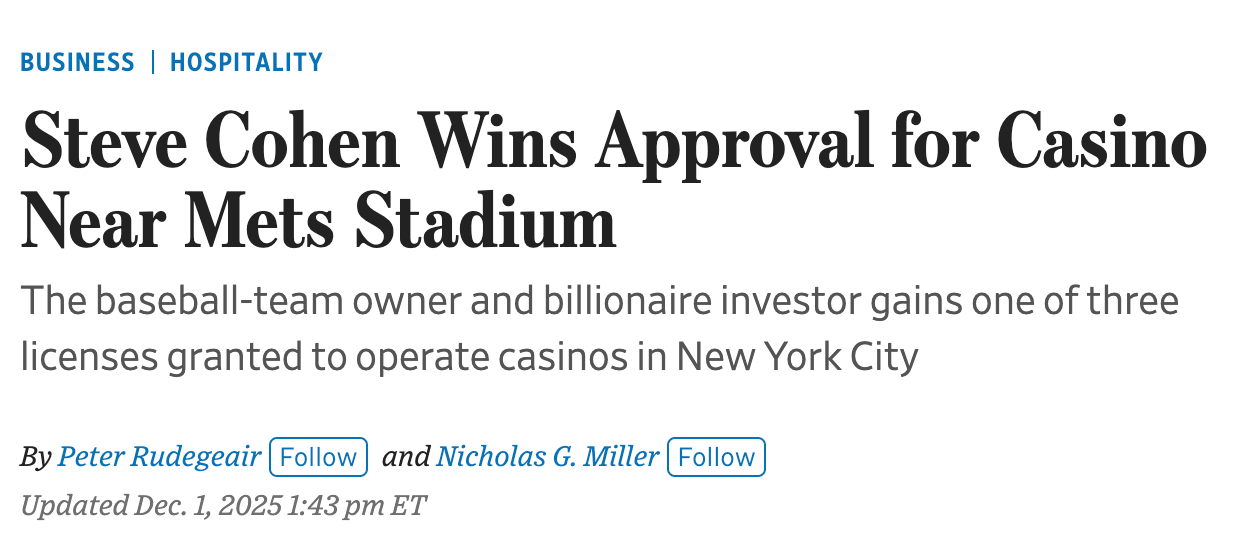
Well, we should be very wary of this logic. Leftists and socialists are often so quick to dismiss the crocodile tears of billionaires that we can miss the implications of this argument. After all, the very things that subsidize team owners are precisely the things that socialists reject about private ownership. That is, the fact that Hal Steinbrenner can, if he’s upset about his team’s cash flow, just cash out and sell his team to some hedge fund billionaire who wants to impress his friends is A BAD THING. The fact that Steve Cohen can use ownership of the Mets to finagle a casino out of public officials is A BAD THING. The fact that leagues are courting private equity and the Saudi royal family as a way to maintain these ever-increasing franchise values is A VERY BAD THING.
And yet, if it weren’t for these features of private ownership, then owners might actually have to make do with the profits generated by the business fundamentals of pro sports. And what a tragedy that would be! How are the Steinbrenners supposed to live on just $700 million per year?? The only solution, I fear, is public ownership of all sports teams. We simply cannot put this burden on our poor billionaires…
The promise of growth is part of why all the leagues went so hard into gambling so fast — it’s one of the few things that offers owners a new source of revenue with no obvious ceiling.